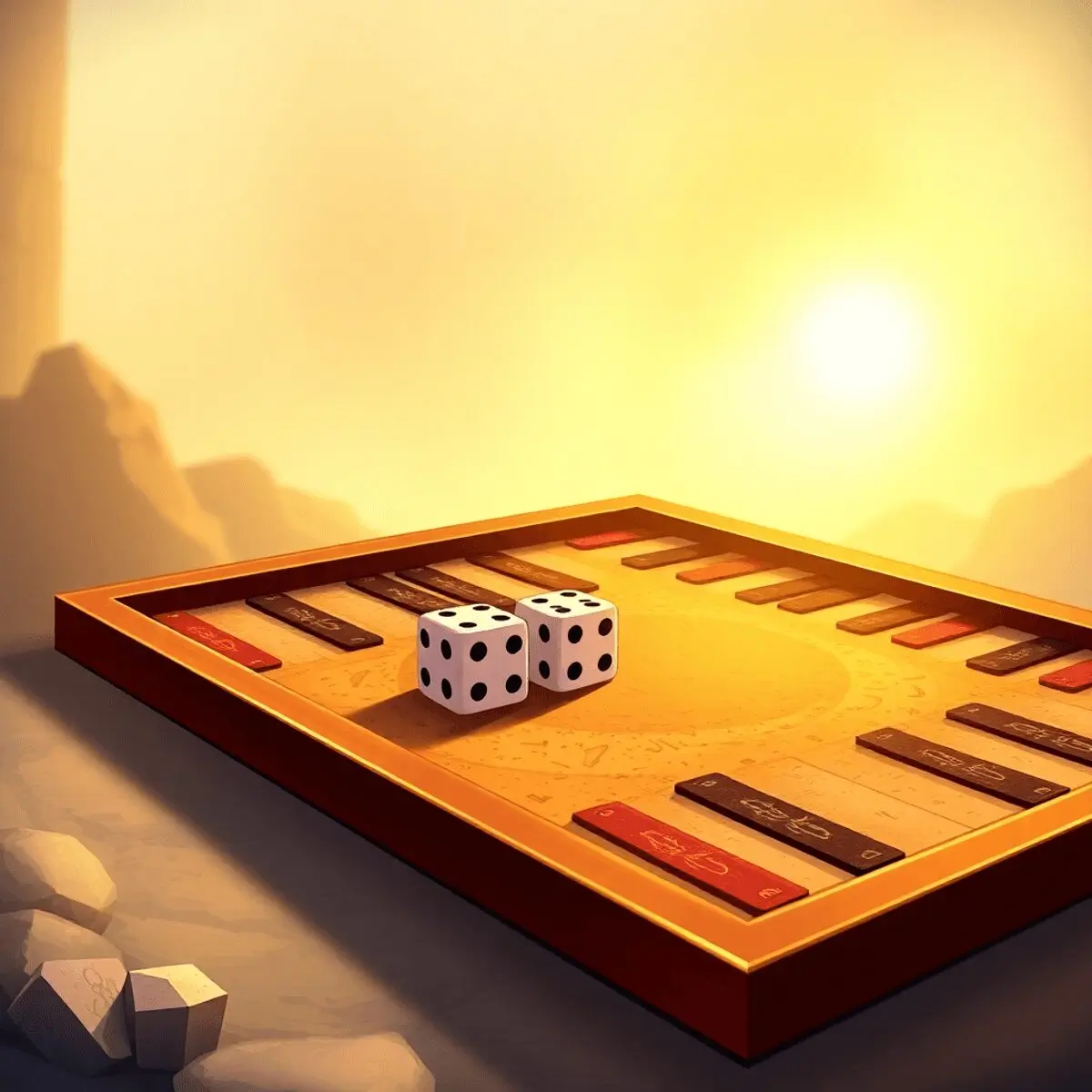
Backgammon is a game that has stood the test of time, captivating players for over 5,000 years. Its rich backgammon history traces a path from ancient Mesopotamia through Egypt and Rome, serving as a powerful testament to the enduring appeal of strategic board games across civilizations.
From ancient Mesopotamian palaces to modern digital platforms, backgammon has managed to stay true to its core essence while adapting to the changing times. This remarkable ability to endure raises interesting questions: What makes a game survive for thousands of years? How has backgammon been able to connect different cultures and withstand technological revolutions?
The answers can be found in backgammon’s unique combination of:
- Strategic depth that rewards skilled players
- An element of chance that levels the playing field
- Simple rules that hide complex possibilities
- Social interaction that builds connections between players
The story of backgammon reflects the story of human civilization itself – a narrative of innovation, cultural exchange, and our innate desire for entertaining experiences. By exploring its journey from ancient times to the present day, we can uncover how this beloved game has evolved while still retaining its fundamental character.
In addition to backgammon, we can also examine the wider world of strategy board games. These games have a rich history and development, influenced by renowned board game designers who have made their mark on
The Dawn of Board Games: Backgammon Among the Oldest Games
Ancient civilizations left us remarkable legacies – among them, the birth of board games. Archaeological discoveries reveal a rich tapestry of gaming culture dating back to 3000 BCE, with backgammon standing as one of humanity’s earliest recreational pursuits.
Evidence from the British Museum
The British Museum houses compelling evidence of these ancient gaming traditions, including carved stone boards and gaming pieces unearthed from Mesopotamian ruins. These artifacts paint a picture of sophisticated gaming communities thriving in the cradle of civilization.
Spiritual Practices and Early Games
A particularly intriguing discovery links these early games to spiritual practices – dice crafted from human bones. These sacred objects served dual purposes:
- Divination tools – used by priests to interpret divine messages
- Gaming pieces – later adapted for recreational play
The transformation from sacred ritual to social entertainment marked a pivotal shift in human culture. Early backgammon precursors emerged as hybrid activities, blending:
- Religious ceremonies
- Mathematical concepts
- Strategic thinking
- Social interaction
Complex Structures Behind Ancient Games
Archaeological findings suggest these games weren’t merely pastimes – they represented complex social structures and belief systems. Gaming boards often featured intricate designs incorporating religious symbols and cultural motifs, while gaming pieces displayed remarkable craftsmanship reflecting their significance in ancient societies.
Shared Human Desire for Games
Interestingly, the discovery of similar gaming patterns across different civilizations indicates a shared human desire for strategic play and social connection through games. This is reflected in the rich variety of traditional board games from around the world, each revealing unique cultural significance and traditions.
The Influence on Backgammon and Modern Classics
These ancient board games laid the foundation for backgammon’s enduring appeal across millennia. Moreover, they paved the way for modern classics, influencing mechanics, themes, and player experiences as seen in the exploration of forgotten predecessors that shaped modern board game classics.
As we delve into the history of classic board games, including their origins and evolution, we can see how they have had a lasting impact on society. This journey is beautifully encapsulated in the timeless journey of classic board games, which explores their historical significance and modern influence.
Furthermore, it is essential to recognize that the mid-20th century marked a golden age for board games, during which mass-market classics emerged and toy companies significantly influenced gaming trends.

Backgammon’s Mesopotamian Roots: Birthplace and Early Development
Ancient Mesopotamia is where backgammon originated. Archaeological discoveries in present-day Iraq have uncovered game boards from as early as 3000 BCE. Among these findings is the Royal Game of Ur, which was found at the Royal Cemetery of Ur by Sir Leonard Woolley’s expedition team (source: Smithsonian Institution).
Early Features of Backgammon in Mesopotamia
The early versions of the game played in Mesopotamia had several distinct characteristics:
- 30 playing pieces divided between two players
- Distinctive triangular markings on wooden boards
- Carved bone dice with markings different from modern dice
- Decorated spaces believed to hold spiritual significance
The Significance of Design in Mesopotamian Backgammon
The physical design of the game reflected both practical and spiritual elements. Game boards incorporated intricate patterns representing the movement of celestial bodies – a crucial aspect of Mesopotamian religious beliefs. Players moved their pieces according to these cosmic patterns, creating a unique blend of entertainment and spiritual practice.
The Social Status of Gaming in Ancient Mesopotamia
Archaeological evidence suggests that these games held significant social status. Clay tablets from the region describe gaming rules passed down through generations, indicating organized gameplay structures. The games served multiple purposes:
- Social gatherings for nobility and common citizens
- Religious ceremonies led by priests
- Military strategy training for soldiers, a purpose that aligns with certain aspects found in the Ranger Handbook, which includes strategic planning and resource management.
- Mathematical education for young scholars
The Spread and Adaptation of Backgammon
The Mesopotamian version of backgammon spread through trade routes, adapting to local customs while still keeping its core mechanics intact. Each civilization that encountered the game added its own unique cultural elements, which contributed to backgammon’s ability to adapt across different societies.
Spread Across Ancient Civilizations: Egypt, Greece, and Rome
Ancient Egypt embraced backgammon-like games with remarkable enthusiasm. Archaeological discoveries in Tutankhamun’s tomb revealed exquisite game boards crafted from ebony and ivory, suggesting these games held significant cultural value. The Senet and Twenty Squares games shared core mechanics with modern backgammon, using dice and strategic piece movement.
Greek civilization elevated board games to philosophical significance. Plato referenced them in his writings as metaphors for life and fate, while Sophocles attributed their invention to the legendary hero Palamedes during the Trojan War. Greek mythology painted Palamedes as a brilliant strategist who created the game to prevent soldier boredom during long sieges.

Rome transformed these games into Duodecim Scripta and Tabulae, versions that closely resembled modern backgammon. Emperor Claudius proved such an enthusiast that he wrote a book about the game and had a special board installed in his chariot. Nero wagered enormous sums on single games, sometimes betting up to 400,000 sesterces.
During the Crusades, backgammon’s rules reflected social hierarchies:
- Nobles played with additional pieces and complex moves
- Merchants followed simplified rule sets
- Common soldiers used basic versions with fewer pieces
The game’s adaptability across social classes and cultures cemented its position as a universal pastime, transcending language barriers and social boundaries.
Medieval Europe and Backgammon’s Evolution Into “Tables”
By the 1200s, backgammon had established itself as “tables” across medieval England, captivating players from all social classes. The game’s popularity soared in noble households, with archaeological discoveries revealing ornate game boards crafted from precious materials like ivory and rare woods.
Church authorities viewed the game with suspicion, particularly due to its gambling associations. Records from the period show numerous attempts to ban “tables” among clergy members, with some religious texts condemning it as a tool of moral corruption. Despite these restrictions, the game thrived in taverns, homes, and royal courts alike.
Literary works of the era paint a vivid picture of the game’s cultural significance. Geoffrey Chaucer’s The Canterbury Tales features characters engaging in heated matches of “tables,” while Shakespeare’s Love’s Labour’s Lost uses the game as a metaphor for life’s unpredictability. These references demonstrate how deeply embedded “tables” had become in medieval society.
The game’s rules underwent significant refinements during this period. Noble households developed their own variations, with some incorporating elements from other popular board games. Surviving manuscripts reveal detailed instructions for different versions of “tables,” suggesting a sophisticated gaming culture that valued both strategy and chance.
The Name “Backgammon”: Origins and Modern Changes
The word “backgammon” first appeared in print around 1645, marking a distinct evolution in the game’s identity. Its linguistic roots trace back to Middle English, combining “bac” (back) and “gamen” (game). This name likely refers to the game’s distinctive feature where pieces move “back” across the board to their home territory.
Changes in Gameplay Mechanics
The 20th century brought revolutionary changes to backgammon’s gameplay mechanics. The introduction of the doubling cube in the 1920s transformed the strategic landscape of the game. This simple six-sided die, marked with numbers 2, 4, 8, 16, 32, and 64, allows players to raise stakes during matches, adding layers of psychological warfare and risk management to traditional gameplay.
The Rise of Online Backgammon
The digital age ushered backgammon into a new era of accessibility. The 1990s saw the emergence of online gaming platforms, connecting players across continents. First Generation Gammon (FIBS), launched in 1992, pioneered internet backgammon play.
Modern platforms feature:
- Advanced match-making systems
- International tournaments
- Real-time gameplay analysis
- Virtual communities for strategy discussions
Professional Backgammon Today
Professional backgammon embraced these technological advances, with major tournaments now streaming matches live and offering substantial prize pools. The game’s core mechanics remain unchanged while digital innovations have expanded its reach to millions of new players worldwide.
Notable Historical Figures Who Played Backgammon
The allure of backgammon captured the interest of many influential figures throughout history.
Thomas Jefferson
Thomas Jefferson, America’s third president, maintained a dedicated backgammon habit at his Monticello estate. His personal letters reveal regular games with his grandchildren and visitors, highlighting backgammon’s role in both entertainment and social bonding.
Roman Emperor Claudius
Roman Emperor Claudius displayed such passion for the game that he wrote a now-lost treatise on backgammon strategy. He famously had a custom board installed in his carriage to play while traveling.
King Canute
King Canute of England and Denmark used backgammon as a diplomatic tool in the 11th century. Historical records show he often engaged in matches with nobles to strengthen political relationships.
King Louis XV
King Louis XV of France elevated backgammon’s status in the 18th century French court. His enthusiasm sparked a trend among aristocrats, who commissioned elaborately decorated boards as status symbols.
These historical players transformed backgammon from a simple pastime into a sophisticated activity associated with strategy, diplomacy, and social refinement.
Why Has Backgammon Endured for Over Five Millennia?
What makes a game survive thousands of years while others fade into obscurity? Backgammon’s remarkable staying power lies in its perfect blend of chance and strategy – a combination that creates endless possibilities in every match.
Unlike ancient games such as Senet or The Royal Game of Ur that disappeared with their civilizations, backgammon adapted and evolved across cultures. Its core appeal stems from three key elements:
- Balanced Gameplay: The mix of dice rolls and strategic decisions creates a level playing field where novices can challenge experts
- Social Interaction: Face-to-face gameplay fosters conversation and connection between players
- Quick Learning Curve: Basic rules can be grasped in minutes, yet mastery takes years
The game’s versatility allowed it to transcend social classes – from peasants to emperors, merchants to scholars. While other ancient pastimes required elaborate equipment or specific cultural knowledge, backgammon’s simple premise of racing pieces home resonated with human nature’s competitive spirit.
This universal appeal combined with its adaptability to different cultural contexts helped backgammon maintain relevance through changing times and societies.
A Living Legacy of Ancient Gaming
Each roll of the dice in backgammon echoes five millennia of human history. This ancient game bridges past and present, connecting modern players to countless generations who have strategized, competed, and bonded over the same board. Its rich heritage spans empires, cultures, and civilizations – from Mesopotamian temples to medieval courts to today’s digital platforms.
The next time you play backgammon, pause to appreciate how this simple yet sophisticated game has captivated minds across time. Whether you’re a seasoned player or curious newcomer, you’re participating in one of humanity’s oldest gaming traditions. Ready to roll the dice and add your chapter to backgammon’s remarkable story?
Want to explore more ancient games? Consider researching other enduring classics like Senet, Go, or Mancala to discover how our ancestors played and competed.