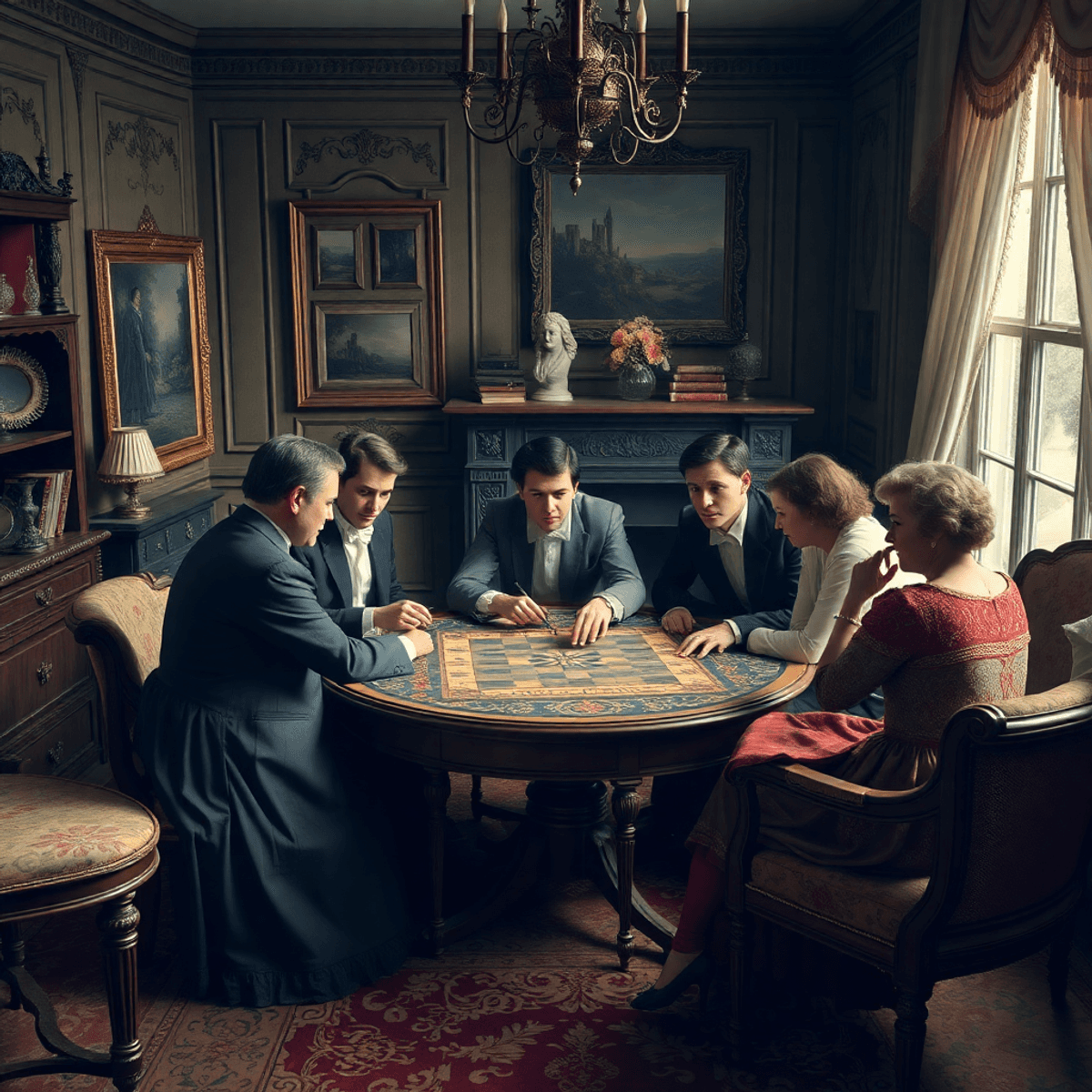
Imagine a dimly lit room filled with friends, each hiding their true identity. Some are innocent villagers, while others are cunning werewolves in disguise. This is the essence of Werewolf, a social deduction game that has captivated players worldwide for decades. The werewolf game history traces back to its roots in Mafia, evolving into one of the most iconic party games of modern times.
Originally created in 1986 as “Mafia” at Moscow State University, this psychological experiment has evolved into a global gaming phenomenon. Its journey from Soviet classrooms to Silicon Valley meetups showcases its universal appeal – the thrill of deception, the challenge of uncovering truth, and the raw excitement of group dynamics.
The game’s brilliance lies in its simplicity: a battle between a small group with knowledge (the werewolves) and a larger group without (the villagers). Survival depends on skills like persuasion, observation, and strategic thinking.
In this exploration, we’ll uncover:
- The fascinating origins of Mafia as a teaching tool
- Its evolution into the werewolf-themed classic we know today
- Core gameplay mechanics that drive social interaction
- Modern interpretations keeping the genre fresh
- Tips for mastering this timeless party game
The Origins of Mafia: A Psychological Experiment Turned Global Sensation
In 1986, psychology student Dimitry Davidoff created a revolutionary teaching tool at Moscow State University that would reshape party gaming forever. His invention, Mafia, started as a clever way to study group dynamics and human behavior under pressure.
The game’s psychological roots run deep. Davidoff designed Mafia to explore various aspects of human behavior such as social manipulation, group decision-making, behavioral patterns under stress, trust dynamics, and conflict resolution.
The game’s success in the classroom sparked immediate interest. Students carried Mafia beyond university walls, spreading it through Soviet youth camps and dormitories. Its popularity exploded across Soviet colleges, with each new group adding their own variations and interpretations.
By the early 1990s, Mafia had crossed borders into Eastern Europe, captivating players with its unique blend of strategy and social interaction. The game’s journey continued westward, reaching the United States where it found eager audiences in universities, tech companies, and social gatherings.
Yet Mafia wasn’t born in a vacuum. The game built upon a rich tradition of hidden-killer party games. In the 1920s, Dorothy Parker’s Algonquin Round Table played Murder in the Dark, a thrilling game of deception in dimmed rooms. Wink Murder, another predecessor, challenged players to catch a secret killer who eliminated victims through subtle winks.
These earlier games laid the groundwork for Mafia’s sophisticated mechanics. Davidoff’s innovation lay in adding structured phases, group voting, and psychological elements that transformed simple party entertainment into a complex social experiment.
The game’s rapid spread through diverse communities proved its universal appeal. From Soviet classrooms to international gaming tables, Mafia demonstrated how a simple psychology experiment could evolve into a global gaming phenomenon.

The Mechanics Behind Mafia and Its Social Deduction Appeal
At its core, Mafia’s gameplay is built on a simple yet fascinating structure of day and night phases. Here’s how it works:
- Secret Roles: At the beginning of the game, players are assigned hidden roles. Most players are innocent villagers, while a few individuals take on the role of the dangerous mafiosi.
- Night Phase: During the night phase, the mafiosi secretly decide who their victim will be while other players keep their eyes closed.
- Day Phase: When day arrives, all players, including the eliminated victim, participate in lively discussions to uncover the identities of the hidden killers.
The Social Dynamics of Mafia
The true appeal of Mafia lies in its intricate social interactions:
- Deception: Mafiosi must craft convincing lies to survive
- Observation: Players analyze body language, voice patterns, and voting behavior
- Memory: Keeping track of contradictions in stories and voting patterns
- Persuasion: Building trust and influencing group decisions
The Psychology Behind Lie Detection
Research from Psychology Today sheds light on how people can detect lies even under pressure. Here are some common signs that indicate someone might be lying:
- Increased pitch in voice
- Minimal hand gestures
- Reduced eye contact
- Delayed responses to questions
These psychological aspects add an extra layer of intensity to Mafia, turning it into a battle of wits. Every accusation creates tension, forcing players to think quickly while maintaining their composure. The game becomes a delicate balance between logic and intuition – analyzing patterns while also interpreting emotional reactions.
The Skills of Expert Players
Skilled players develop an almost instinctual ability to spot deception, learning to pick up on subtle facial expressions and inconsistencies in behavior. This combination of strategic thinking and psychological tactics creates an addictive gameplay loop that has fascinated players for many years.
Moreover, understanding the tactics manipulators use can further enhance a player’s ability to navigate through the complexities of Mafia’s social dynamics.
From Mafia to Werewolf: Reinventing a Classic in 1997
Andrew Plotkin’s 1997 reimagining of Mafia marked a pivotal moment in social deduction game history. During a gaming convention, Plotkin transformed the criminal underworld theme into a supernatural horror setting, replacing mafiosi with werewolves and villagers with townsfolk.
The werewolf theme resonated deeply with players, tapping into primal fears and classic horror tropes. This thematic shift created rich storytelling opportunities:
- Nighttime transformations added suspense and drama
- Full moon imagery enhanced the game’s mystical atmosphere
- Medieval village setting sparked players’ imaginations
Plotkin’s version introduced strategic elements that deepened gameplay:
- The Seer role gained thematic significance as a mystic villager
- Wolf pack dynamics replaced individual mafia decisions
- Day/night cycle aligned naturally with werewolf mythology
Tech communities quickly adopted Werewolf at conferences and meetups. The game’s blend of logic and social manipulation appealed to programmers and engineers who appreciated its:
- Complex probability calculations
- Information theory principles
- Group psychology dynamics
- Real-time strategy elements
Silicon Valley embraced Werewolf as both entertainment and team-building exercise. Tech giants like Google and Facebook incorporated the game into their corporate culture, using it to develop:
- Communication skills
- Leadership abilities
- Problem-solving under pressure
- Team cohesion
The game’s success in tech circles helped spread its popularity globally, establishing Werewolf as the definitive version of the social deduction format.
This transformation from Mafia to Werewolf is not just a simple change of theme; it’s a profound shift that reflects the evolution of social deduction games. The werewolf variant has become a staple in various settings, including tech conferences where it serves as an engaging tool for team building, fostering essential skills such as communication and leadership. Furthermore, the game’s intricate design also provides valuable insights into group psychology, making it not only a source of entertainment but also a powerful resource for personal and professional development.
Popular Social Deduction Games Inspired by Mafia/Werewolf
The success of Mafia/Werewolf sparked a creative explosion in social deduction gaming. Modern game designers have built upon its foundation, which is rooted in the influence of forgotten board games, to create innovative titles that push the boundaries of hidden role mechanics.
1. The Resistance
The Resistance revolutionized the genre by eliminating player elimination – a common criticism of traditional Werewolf games. Set in a dystopian future, players work as either resistance fighters or government spies. The game’s genius lies in its mission system, where teams must be approved by group vote before attempting missions that can be secretly sabotaged.
2. Secret Hitler
Secret Hitler brings social deduction to 1930s Germany, where liberals attempt to prevent fascists from taking power. The game introduces a unique policy deck mechanic that creates tension through legislative decisions, while the role of Hitler adds an extra layer of deception as fascist players must protect their leader’s identity.
3. One Night Ultimate Werewolf
One Night Ultimate Werewolf addresses another classic Werewolf pain point: game length. By condensing play into a single night phase followed by one day of discussion, it creates intense 10-minute rounds perfect for multiple plays. The game features:
- Role switching during the night phase
- A companion app that guides gameplay
- Complex role interactions that create surprising scenarios
4. Among Us
Among Us adapted social deduction for the digital age, proving the genre’s adaptability. Players complete tasks aboard a spaceship while trying to identify the impostor sabotaging their mission. Its simple mechanics and visual style made social deduction accessible to millions of new players.
These innovations demonstrate how designers continue finding fresh ways to capture the psychological tension that made the original Mafia game so compelling. Each new title adds unique mechanics while preserving the core thrill of deception and discovery.
How to Play Werewolf: A Beginner’s Guide
Ready to join the thrilling world of social deception? Here’s your essential guide to playing Werewolf:
Game Setup
- Gather 7-15 players
- Select a moderator to guide the game
- Deal role cards face-down to each player
- Basic roles include:
- Werewolves (2-3 players)
- Villagers (majority of players)
- Optional special roles like Seer or Doctor
Night Phase
- All players close their eyes
- Moderator calls werewolves to wake up
- Werewolves silently choose one victim
- Werewolves return to sleep
- Special roles perform their actions
Day Phase
- Moderator announces the night’s victim
- Players discuss suspicious behavior
- Group votes to eliminate one suspect
- Eliminated player reveals their role

Pro Tips for New Players
- Stay observant: Watch for unusual behavior patterns
- Take notes: Track voting patterns and contradictions
- Build trust: Form alliances but remain flexible
- Control reactions: Keep a poker face when accused
- Ask questions: Probe inconsistencies in others’ stories
Winning Strategy
- Villagers win by eliminating all werewolves
- Werewolves win by matching or outnumbering villagers
- Success depends on social awareness and strategic thinking
Remember: The best defense is often a good offense – participate actively in discussions while maintaining your cover story. Your ability to read social cues and adapt your strategy will improve with each game.
Why Mafia/Werewolf Remains the Top Social Deduction Game
Mafia/Werewolf has remained popular for so long because it combines psychological elements that create an intense social experience. Players must navigate a complex web of:
- Emotional Intelligence – Reading facial expressions, tone shifts, and body language
- Logical Deduction – Analyzing voting patterns and behavioral inconsistencies
- Strategic Thinking – Managing information and building trust networks
- Democratic Process – Participating in group decision-making under pressure
This mix of skills makes the game really engaging and reflects real-life social dynamics. Studies show that regular players become better at detecting lies through repeated interactions with familiar groups, even more than what formal training can achieve.
Adaptability Across Communities
The game’s ability to adapt has led to its widespread use in various communities around the world. For example:
- In Silicon Valley, tech companies use Werewolf sessions for team building and developing social skills.
- Refugee camps have embraced the game as a way to build trust and foster community connections despite language barriers.
Accessibility’s Role in Longevity
The game’s accessibility is also a key factor in why it has lasted so long:
- Requires minimal equipment
- Adapts to different group sizes
- Crosses cultural boundaries
- Creates shared experiences
Depth of Experience
The psychological depth of Mafia/Werewolf turns simple mechanics into complex social interactions. Each game session becomes a unique story of deception, alliance-building, and collective problem-solving. This rich social fabric has helped the game maintain its position as the ultimate social deduction experience, inspiring many variations while staying true to its core appeal of human interaction and psychological warfare.
Conclusion
The enduring legacy of Mafia/Werewolf extends far beyond its humble beginnings as a psychology teaching tool. This game has shaped the landscape of social deduction gaming, creating ripples that influence modern game design and social interaction.
Ready to dive into this fascinating world? Gather your friends, designate a moderator, and experience the thrill of uncovering hidden werewolves or masterfully deceiving your fellow villagers. Each session offers unique insights into human behavior and sharpens your ability to read social cues.
The beauty of Mafia/Werewolf lies in its accessibility – all you need are people willing to engage in strategic thinking and social manipulation. Whether you’re a board game enthusiast or new to social deduction games, the psychological depth and strategic elements will keep you coming back for more.
Looking to expand your gaming horizons? Let Mafia/Werewolf be your gateway into the rich world of social deduction games, where each title offers fresh perspectives on group dynamics and human psychology.
This journey could also lead you to explore traditional board games from around the world, each revealing unique cultural significance and rich traditions behind them. You might even discover some insights on famous board game designers, their innovative creations, and lasting impact on the gaming industry.
Furthermore, understanding the golden age of board games from the 1950s-1970s could provide valuable context to modern gaming trends. Lastly, delving into the history of ancient and medieval board games can offer a fascinating perspective on how these games have shaped our cultural landscape over time.